How 13th-Century Italian Glassmakers Sparked the Invention of Eyeglasses
Meta Description:
Discover how 13th-century Italian glassmakers revolutionized vision with the invention of eyeglasses, transforming society, science, and modern technology.
More detail other website
Introduction
The story of the invention of eyeglasses is not just about clearer vision—it’s about human curiosity, craftsmanship, and the relentless pursuit of progress. Imagine living in a world where aging or poor eyesight meant losing the ability to read, create art, or perform intricate work. That was the reality before a remarkable group of 13th-century Italian glassmakers changed history forever.
During the Middle Ages, as literacy and scholarship began to grow across Europe, the need for vision aids became more pressing. Monks, scholars, and craftsmen struggled to read manuscripts or perform detailed tasks as their eyesight weakened. It was within this setting that the first eyeglasses were born—crafted not by scientists, but by skilled artisans who worked with molten glass in the cities of Venice and Pisa.
Their creation marked a turning point in human history, paving the way for advances in science, art, and education. Let’s journey back to the roots of this remarkable innovation and uncover how these Italian pioneers sparked a revolution in vision that continues to evolve to this day.
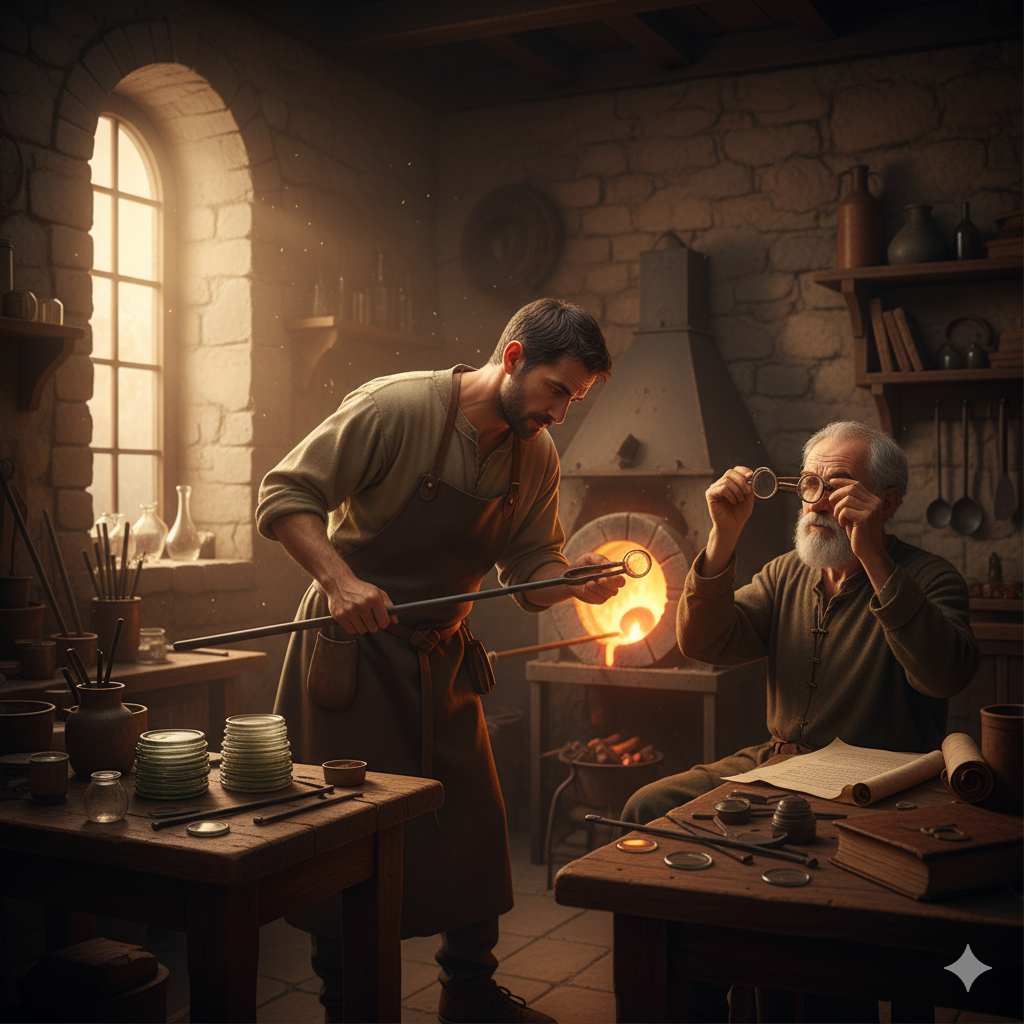
Early Vision Aids: A Glimpse Before Eyeglasses
Long before the invention of eyeglasses, people sought ways to improve their eyesight. Ancient civilizations, including the Egyptians, Greeks, and Romans, understood the importance of vision and experimented with primitive optical tools.
The Roman philosopher Seneca (4 BCE – 65 CE) is said to have used a glass globe filled with water to magnify text, while Emperor Nero reportedly watched gladiator games through a polished emerald. These early experiments revealed that curved glass or crystals could alter light and improve visual clarity.
By the 10th and 11th centuries, Arab scholars expanded on Greek optical theories. The great physicist Alhazen (Ibn al-Haytham) studied the nature of light and vision, laying the foundation for later optical discoveries. Although these findings didn’t directly produce eyeglasses, they formed the scientific groundwork upon which the 13th-century Italian glassmakers would later build.
The 13th-Century Breakthrough: Birth of the Spectacles
The real invention of eyeglasses took place in the late 1200s, a time when Europe was undergoing intellectual and artistic transformation. Scholars needed tools to extend their working years, and artisans sought precision in their crafts.
Around the year 1285 to 1290, the first wearable spectacles emerged in northern Italy—particularly in Venice and Pisa, two hubs of glassmaking excellence. These early eyeglasses consisted of two convex lenses mounted in frames that could be balanced on the nose or held by hand.
The earliest written reference to eyeglasses dates back to 1306, when Friar Giordano da Pisa mentioned them in a sermon, noting that they had been invented “less than twenty years ago.” This confirms their creation sometime in the late 13th century.
Though the name of the original inventor remains uncertain, several names often surface—Salvino D’Armate of Florence being one of them, though historians debate the claim. Regardless of who first combined lenses into a wearable form, what’s certain is that this innovation emerged from the unique expertise of Italian glass artisans.
Adobe QR Code Generator Ultra HD print download

The Role of Italian Glassmakers
Italy’s glassmaking tradition was centuries old by the time eyeglasses appeared. The island of Murano, near Venice, was already famous for producing the finest and clearest glass in Europe. These artisans had mastered the art of melting sand, soda, and lime to create pure, transparent glass—an essential ingredient for optical precision.
When scholars and monks began demanding visual aids, it was natural that Italian glassmakers rose to the challenge. They experimented with shaping and polishing small glass discs into convex forms that magnified objects. Over time, they learned how to match lenses with specific visual needs, particularly for presbyopia, the age-related difficulty in seeing up close.
The production of eyeglasses quickly spread from Venice to Florence and across Europe. Italy’s craftsmanship and trade networks ensured that the new invention reached scholars, merchants, and artisans across the continent.
By the early 14th century, eyeglasses were no longer rare curiosities—they were valuable tools for intellectual and practical work. The Italian glassmakers of the 13th century didn’t just create a device; they ignited an optical revolution that continues to shape human progress.
Evolution of Eyeglasses Through the Centuries
The invention of eyeglasses was only the beginning. Over the following centuries, improvements in design, materials, and optical science transformed these early spectacles into the sophisticated vision aids we know today.
14th–16th Centuries: Refinement and Expansion
Early spectacles had no temples and had to be balanced on the nose or held by hand. By the 15th century, spectacles became more refined and widely available. The invention of the printing press by Johannes Gutenberg in 1440 increased the demand for reading glasses dramatically.

17th–18th Centuries: Scientific Advances
The age of scientific discovery brought improved understanding of optics. Isaac Newton and others studied the behavior of light, influencing lens design. Around the 18th century, Benjamin Franklin famously invented bifocals, combining lenses for distance and reading into one frame—an innovation that remains influential today.
19th Century: Industrial and Design Progress
The Industrial Revolution introduced mass production, making eyeglasses affordable to the general public. Metal frames, adjustable temples, and better lens-grinding techniques became standard. Optometrists and opticians emerged as professional fields, further advancing precision.
20th–21st Centuries: From Glass to Smart Vision
In the 20th century, lenses evolved from glass to lightweight plastics, and coatings were developed to resist glare, scratches, and UV rays. Modern times introduced contact lenses, laser eye surgery, and smart glasses, bridging the gap between vision correction and digital technology.
From the medieval workshops of Venice to the digital labs of Silicon Valley, eyeglasses have undergone an extraordinary transformation spanning more than 700 years.
Impact on Society, Education, and Science
The invention of eyeglasses revolutionized more than just vision—it reshaped society. Scholars and artisans could now extend their productive years, fueling advances in art, science, and education.
During the Renaissance, artists like Leonardo da Vinci and scholars such as Galileo Galilei benefited from optical innovations inspired by early eyeglasses. The ability to read and study longer led to the rapid growth of knowledge, universities, and literacy.
In practical life, eyeglasses also became symbols of wisdom and intelligence. Portraits from the 15th century onward often depicted scholars wearing spectacles, reinforcing their association with learning and respectability.
Beyond culture, the optical principles behind eyeglasses paved the way for major scientific instruments—microscopes, telescopes, and cameras—all of which rely on the same basic understanding of lenses and light refraction. Thus, eyeglasses didn’t just correct sight; they expanded the way humanity sees the universe.
Modern Innovations Inspired by the Invention of Eyeglasses
The story of the invention of eyeglasses doesn’t end with clearer vision. It continues in today’s technology-driven world.
Modern eyewear has evolved far beyond simple glass lenses. We now have progressive lenses, anti-glare coatings, photochromic lenses that adapt to light, and contact lenses that are nearly invisible.
The latest frontier is smart glasses, blending digital innovation with optical engineering. Devices like Google Glass and Meta’s AR glasses merge augmented reality with traditional vision correction, echoing the same inventive spirit that drove 13th-century Italian glassmakers.
These innovations remind us that a small spark of creativity in medieval Italy ignited a legacy that connects the past to the future of human perception.
The Mystery of the First Inventor of Eyeglasses: Salvino D’Armate, Roger Bacon, and the 13th-Century Vision Revolution
Introduction: Searching for the First Inventor of Eyeglasses
The story of the first inventor of eyeglasses is one wrapped in both clarity and mystery. While eyeglasses themselves revolutionized the way humans see the world, the identity of their creator has been blurred by the passage of time. Historians often mention Salvino D’Armate, a 13th-century Florentine, as the first to design wearable spectacles. Others credit the English philosopher Roger Bacon, whose scientific writings on optics laid the theoretical foundation for the invention.
What we do know for certain is that around the year 1286 in Italy, a revolutionary leap occurred — the first functional eyeglasses were crafted. This breakthrough didn’t come from a single flash of inspiration, but from decades of experiments in light, glass, and vision. It was an invention that changed how humanity perceived knowledge, art, and even itself.
13th-Century Europe: The Age of Discovery and Glassmaking Genius
To understand the origins of the invention of eyeglasses, we must first step into the world of 13th-century Europe. This was an era of transformation — a time when art, science, and trade flourished across Italy’s city-states.
Venice, Pisa, and Florence were centers of craftsmanship and innovation. Glassmaking, in particular, reached new heights on the island of Murano, where Italian artisans perfected techniques for producing transparent and finely polished glass. Scholars across Europe were translating Greek and Arabic scientific texts, sparking a renewed interest in optics and light.
It was within this vibrant atmosphere of curiosity and craftsmanship that the first inventor of eyeglasses emerged — bridging science and artisan skill to solve a deeply human problem: poor eyesight.
malikhost.com Advanced Tools Hub | 100% Free Online Tools

Salvino D’Armate: The Legendary Florentine Inventor
Among the most widely mentioned names in the history of spectacles is Salvino D’Armate of Florence. According to local legend, he was the first person to invent eyeglasses around 1286.
A 17th-century inscription in Florence reads:
“Here lies Salvino degli Armati of Florence, inventor of eyeglasses. May God forgive his sins. A.D. 1317.”
While historians debate the authenticity of this claim, the legend persisted for centuries, earning D’Armate a place in Italian history as the man who changed human vision. Some scholars argue that his contribution may not have been purely inventive but rather practical — improving upon the experimental optical lenses already being developed by monks and glassmakers.
Whether or not Salvino D’Armate was truly the inventor, his name symbolizes the creative spirit of Florence — a city that gave the world some of the greatest minds in art and science.
Roger Bacon and the Science Behind Eyeglasses
Before D’Armate’s time, another brilliant mind had already laid the groundwork for understanding how lenses could improve vision. Roger Bacon, an English philosopher and Franciscan friar, lived between 1219 and 1292 — decades before the confirmed creation of spectacles.
Bacon’s studies in optics were groundbreaking. In his work Opus Majus, written around 1268, he discussed the magnifying properties of convex lenses and how they could assist aging eyes. He wrote:
“If a man look through a glass or crystal of suitable shape, he shall see letters or small objects more clearly and larger than they are.”
While Bacon never produced or wore eyeglasses himself, his theoretical insights paved the way for the first inventor of eyeglasses to turn optical science into a real, wearable solution. His ideas connected philosophy with practical experimentation — a true Renaissance vision, decades before the Renaissance began.
Crafting the First Spectacles: Techniques, Materials, and Challenges
The 13th-century Italian glassmakers who shaped the first lenses worked without modern tools, relying entirely on their hands, eyes, and intuition. The lenses were made of blown glass — a technique perfected in Venice’s Murano workshops. Artisans melted sand, soda, and lime in hot furnaces, forming clear, colorless discs that could be ground and polished into the desired curvature.
Creating a lens that accurately refracted light required patience and extraordinary precision. Early lenses were convex, designed to aid presbyopia (farsightedness), a common problem among aging scholars and monks who copied manuscripts. These lenses were mounted into simple frames made of wood, horn, or metal, joined at the center with rivets so they could be balanced on the nose or held by hand.
The first inventor of eyeglasses, whoever he may have been, faced immense challenges — achieving optical balance, shaping uniform curvature, and ensuring the glass was clear enough to magnify without distortion. Yet the success of these early spectacles proved that humanity had finally conquered one of its oldest physical limitations: the decline of sight with age.
The Spread of the Invention Across Italy and Europe
Once the first spectacles appeared, likely in Pisa or Venice, their usefulness spread rapidly. Monks and scholars were among the first adopters, using them to read sacred texts and illuminate manuscripts well into the night.
By the early 14th century, references to eyeglasses appeared in written records and artwork. In 1306, Friar Giordano da Pisa gave a sermon in Florence, stating:
“It is not yet twenty years since there was found the art of making eyeglasses, one of the best arts ever discovered.”
This quote is one of the earliest confirmed references to the invention of glasses, placing their origin around the 1280s — precisely aligning with Salvino D’Armate’s timeline. Within a century, spectacles were being traded across Europe. German craftsmen began producing them in Nuremberg, while English and French scholars adopted them as intellectual tools.
By the Renaissance, eyeglasses had evolved into a symbol of learning and wisdom. Artists like Tommaso da Modena even depicted monks wearing spectacles in paintings as early as 1352 — a sign that the invention had already become part of European culture.
Historical Debates and Lost Records
Despite these records, the identity of the first inventor of eyeglasses remains uncertain. Some historians argue that the Florentine claim of Salvino D’Armate was a later patriotic legend, created to celebrate Italy’s contribution to science. Others believe that the true inventor was an anonymous Venetian craftsman, working in the secretive glassmaking guilds of Murano.
Regardless of the name, one thing is clear: the invention was not an isolated event but a culmination of centuries of optical study — from ancient Greek theories to Arab advancements in light and reflection, and finally, to Italian craftsmanship that turned theory into practice.
The blurred origins themselves reflect the very purpose of eyeglasses — bringing clarity where once there was obscurity.
A Vision That Changed the World
The invention of eyeglasses in the 13th century marked a profound turning point in human history. For the first time, people could extend their intellectual lifespan, continuing to read, write, and innovate long after age dimmed their natural sight.
The work of pioneers like Roger Bacon and Salvino D’Armate lit the spark for a lineage of optical innovation that would lead to microscopes, telescopes, contact lenses, and even modern smart glasses.
The first inventor of eyeglasses, whether known or unknown, changed more than eyesight — he changed the way humanity sees the world itself.
Conclusion
The invention of eyeglasses in 13th-century Italy was more than an optical breakthrough—it was a turning point in human civilization. By transforming how people saw the world, Italian glassmakers unlocked new possibilities for learning, craftsmanship, and exploration.
From the early convex lenses of Murano artisans to the high-tech smart glasses of today, every innovation traces back to that pivotal moment in history when vision met ingenuity. Eyeglasses remind us that progress often begins with the simplest desire—to see the world more clearly.
The next time you put on your glasses or contact lenses, remember: you’re wearing the legacy of the brilliant minds and hands that, centuries ago, forever changed how humanity views itself and its world.
FAQs About the Invention and History of Eyeglasses
1. Who invented eyeglasses?
The exact inventor remains unknown, but eyeglasses were first created in northern Italy during the late 13th century, likely by Venetian or Pisan glassmakers.
2. When were the first eyeglasses made?
Eyeglasses were invented around 1285–1290 CE, with the earliest written mention appearing in a sermon from 1306.
3. What were the first eyeglasses made of?
Early spectacles used convex glass lenses set in frames made of wood, leather, or metal. They had no temples and were balanced on the nose.
4. Who is Salvino D’Armate?
Salvino D’Armate is often credited with inventing eyeglasses, but there’s little historical evidence to confirm this claim.
5. How did eyeglasses improve over time?
Over the centuries, frames became more comfortable, lenses more precise, and styles more diverse—eventually leading to bifocals, plastic lenses, and smart eyewear.
6. Why were Italian glassmakers key to this invention?
Italian glassmakers had perfected high-quality glassmaking on Murano Island, providing the clear material necessary for crafting precise optical lenses.
7. How did eyeglasses change society?
They extended human productivity, enabling scholars, artists, and scientists to work longer, leading to rapid cultural and intellectual growth during the Renaissance.
8. When did eyeglasses become common?
By the 15th century, eyeglasses were widely used across Europe, especially after the invention of the printing press increased reading demands.
9. What came after eyeglasses?
The next major milestones were contact lenses in the 20th century and, later, digital smart glasses that integrate augmented reality technology.
10. What’s the future of eyeglasses?
Future eyewear will likely merge AI, sensors, and augmented vision—combining medical precision with digital connectivity to enhance both sight and experience.
Hashtags
#InventionOfEyeglasses #EyeglassesHistory #ItalianGlassmakers #VisionInnovation #OpticalRevolution #HistoryOfScience #SmartGlasses #RenaissanceInvention #MuranoGlass #HumanInnovation